What does TESU preceptor placement cost?
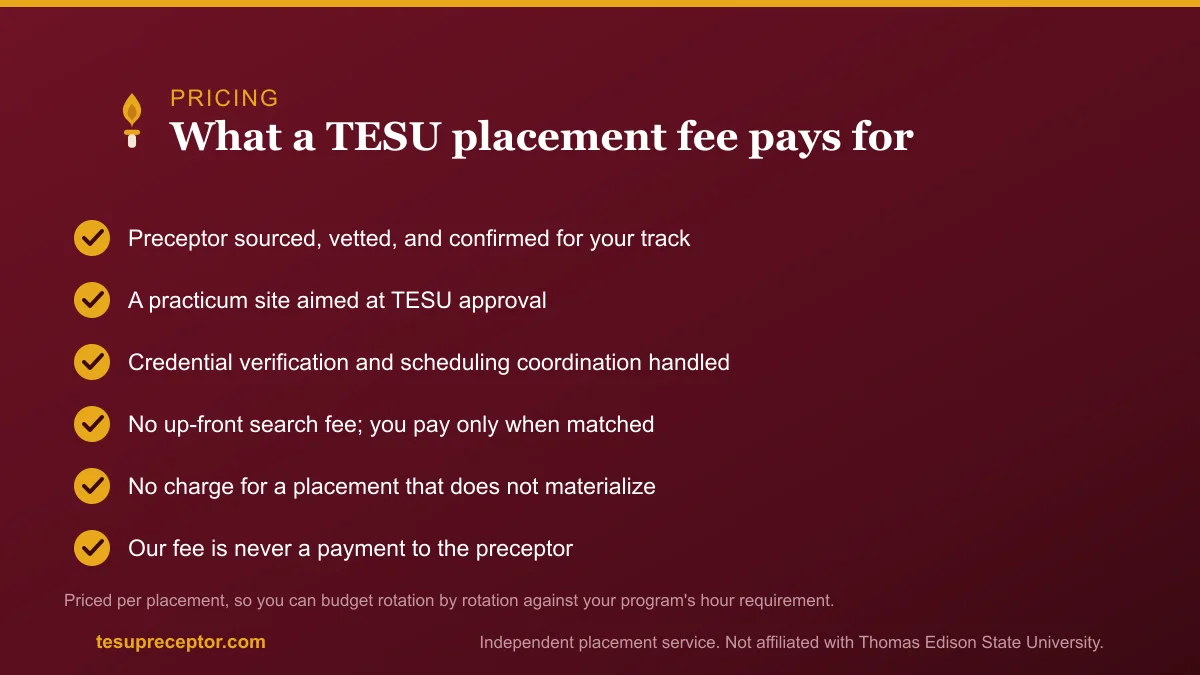
Independent preceptor placement generally runs about 1,500 to 2,500 dollars per rotation across the market, with psychiatric mental health placements often landing at the higher end because psych preceptors are scarcer, and here is how we price against that: we charge per placement, you pay only when you are matched, and our fee covers sourcing, verification, and coordination, never a payment to the preceptor. This guide breaks down the market range, what our fee actually buys, why we bill per placement instead of up front, and the cost of a delayed term for a working nurse, so you can weigh the real total cost rather than just the sticker.
Tell us your program and city. It is free to ask, with no obligation.
How much does an independent preceptor placement cost?
Across the independent placement market, a single rotation generally costs about 1,500 to 2,500 dollars, and psychiatric mental health (PMHNP) placements tend to sit toward the top of that range because qualified psych preceptors who will take a student are harder to find. That market range is your baseline for comparison, and any service charging far outside it deserves a hard question about what you are actually getting.
Your total across a program depends on how many rotations you need, which comes straight from your program's hour requirement. A 750-hour FNP load, a DNP minimum of 1,000 post-baccalaureate hours with at least 500 at TESU, and a 100-hour-per-course MSN specialization practicum are very different footprints, so the smart move is to map your full hour requirement first and then plan placement spend against it rather than pricing one rotation in isolation.
| Program | Hours to place around | Rotation planning note |
|---|---|---|
| MSN FNP | 750 clinical hours | Multiple clinical courses across 14 courses |
| MSN PMHNP | 750 direct-patient-care hours | One-on-one clinical components; limited approved telemedicine under the current guide |
| Post-Master's PMHNP certificate | 750 supervised direct-patient-care hours | Direct-care NP certificate, 31 credits |
| MSN specializations | one required 100-hour NUR-7510 practicum in the current catalog | Student also arranges an approvable project |
| DNP (Systems-Level Leadership) | Minimum 1,000 hours, 500+ at TESU | Plan placement only around the portion outside TESU as applicable |
How do you price, and when do I pay?
We price per placement, and you pay only when you are matched with a preceptor and site that fit your program. There is no up-front search fee and no charge for a placement that does not materialize, which means we only get paid when we have actually solved the problem you came to us with. That structure is deliberate: it keeps our incentive pointed at finding you a real, approvable rotation rather than collecting money to start looking.
Pricing per placement also makes your budgeting honest. You can plan spend rotation by rotation against your program's hour requirement instead of committing a large lump sum against an uncertain outcome. If you need one rotation, you pay for one. If your program requires several, you can pace the placements, and the cost tracks the work delivered rather than a subscription you have to keep paying whether or not you get matched.
What does the fee actually pay for?
Our fee pays for the sourcing, credential verification, and coordination work of finding and confirming a preceptor and site that meet your TESU program's requirements. It pays for the hours spent identifying preceptors who will actually say yes, checking that their credentials and setting fit your track, and handling the back-and-forth to get a placement confirmed on a schedule that fits a working nurse. That is skilled logistics work, and it is what you are buying.
The fee is never a payment to the preceptor. Preceptors are not paid by us, and paying a preceptor is not part of our model. We say this bluntly because it is a common and fair worry: you are not routing a kickback to a clinician through us. You are paying an independent service for the search and the coordination.
- Sourcing: identifying qualified preceptors and sites that match your program and specialty.
- Verification: checking credentials and site fit against your track's requirements.
- Coordination: managing scheduling and confirmation so you can focus on coursework and clinicals.
- Not included: any payment to the preceptor, malpractice insurance, or your school's final approval, which is always TESU's decision.
Why psych (PMHNP) placements often cost more
Psychiatric mental health placements often sit at the higher end of the 1,500 to 2,500 dollar market range because qualified PMHNP preceptors who have capacity to take a student are genuinely scarce, and scarcity drives cost in placement the same way it does anywhere else. If you are in the TESU MSN PMHNP track or the Post-Master's PMHNP certificate, plan for the possibility that a psych rotation lands nearer the top of the range.
This is also why starting your search early matters most for psych students. The thinner the pool of available preceptors, the more lead time you need, and the more a last-minute scramble costs you in both dollars and delay. We would rather set that expectation honestly than let a psych student assume a placement will come together as quickly and cheaply as a primary-care one might.
The real cost is a lost term, not just the fee
For a working nurse, the largest cost in this whole equation is usually not the placement fee, it is a delayed graduation. If you cannot line up an approvable preceptor and site before a practicum term opens, you do not just wait a few weeks, you often wait for the next term the course runs, and that can push your graduation back months. Weigh the fee against that, not against zero.
Put concrete numbers on it in your own case. A term of delay is a term longer before you are practicing and earning at the NP or advanced level you are training for, plus the momentum and confidence you lose stepping away from a program you were mid-stride in. For most working adults, the earnings and time lost to a single delayed term dwarf the difference between doing the search yourself and paying a market-rate placement fee to get it done on schedule.
That is the honest cost-of-delay argument, and it cuts both ways: it is exactly why we price only when we match you, because a fee you pay for a placement that never comes through does nothing to protect your timeline. You should only pay when the delay risk is actually retired by a confirmed match.
What is not included, and who to confirm with
Our fee does not include malpractice insurance, which TESU requires you to carry before you register for practicum courses, and it does not include your school's final approval of a preceptor, site, or project, which is always TESU's decision. Budget for malpractice separately and treat school approval as a step outside our control, because pretending otherwise would be dishonest pricing.
We are an independent service and we work independently of Thomas Edison State University or CCNE. Anything about required hours, eligible preceptors, site standards, project approval, or the accreditation status of a program (including the Post-Graduate APRN certificate, which is pursuing initial CCNE accreditation and is not yet accredited) should be confirmed directly with TESU before you rely on it.
Good to know
How much does TESU preceptor placement cost?
Independent placement generally runs about 1,500 to 2,500 dollars per rotation market-wide, with psych placements often higher. We price per placement and you pay only when matched.
Do I pay before or after you find a preceptor?
You pay only when you are matched. There is no up-front search fee and no charge for a placement that does not happen.
Does your fee pay the preceptor?
No. Preceptors are not paid by us. The fee covers sourcing, verification, and coordination of your placement, never a payment to the clinician.
Why might a PMHNP placement cost more?
Psychiatric preceptors with capacity to take a student are scarcer, so psych placements often land at the higher end of the market range. Start early if you are a PMHNP student.
Is malpractice insurance included in the fee?
No. TESU requires you to carry malpractice insurance before registering for practicum, and you arrange that separately. Our fee does not cover it.
Do not let the search cost you a term
Tell us your TESU program, your city, and your practicum timeline. We will come back with a placement plan and a realistic path to a preceptor and your clinical hours.