How it works: your TESU practicum placement in four steps
Here is the whole process: you tell us your Thomas Edison State University nursing program and state, we source and verify a qualified preceptor and clinical site, we hand you a documented package so you can clear TESU eligibility and malpractice requirements, and then you register and log your hours. We are an independent sourcing and coordination service, separate from TESU or CCNE. Our fee covers finding and verifying the preceptor and coordinating the paperwork; we never pay the preceptor, and the preceptor is not paid by us.
Tell us your program and city. It is free to ask, with no obligation.
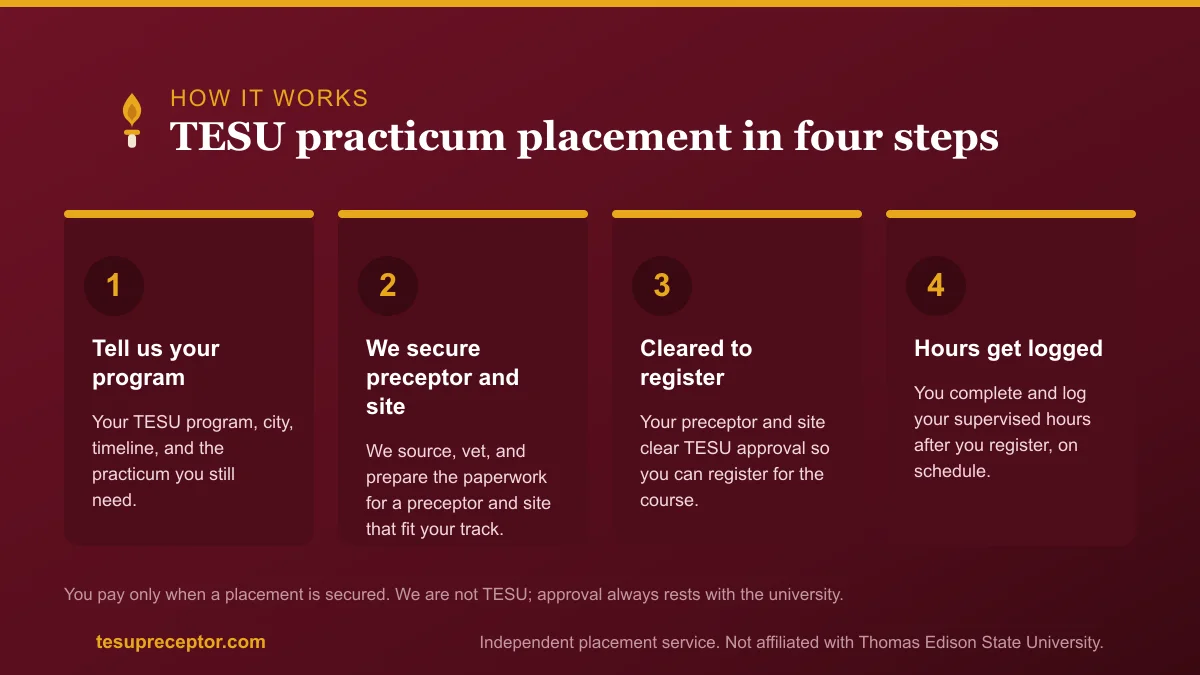
What are the four steps to a TESU practicum placement?
The four steps are: (1) tell us your program, (2) we secure your preceptor and site, (3) you get cleared to register with eligibility and malpractice in hand, and (4) you log your hours toward your total. Each step below explains exactly what happens and what we hand you before you move to the next one.
| Step | What happens | Who does it |
|---|---|---|
| 1. Tell us your program | You share your TESU track, state, target term, and preferences | You |
| 2. Preceptor and site secured | We source, vet, and confirm a qualified preceptor and clinical site | We do |
| 3. Cleared to register | You submit our package plus malpractice proof for TESU approval | You, with our package |
| 4. Hours logged | You attend the site and log clinical hours toward your total | You and your preceptor |
Step 1: How do I tell you my program so you can start?
You start by telling us which TESU nursing track you are in, the state where you need placement, your target practicum term, and any scheduling constraints. That single intake is enough for us to begin sourcing, because the requirement is different for each track.
We serve the MSN-FNP, the MSN-PMHNP, the Post-Master's PMHNP certificate, the three MSN specializations (Nurse Educator, Nursing Informatics, and Nursing Administration), and the DNP. If you are in the Accelerated BSN or the plain RN-to-BSN, we are not the right fit: the Accelerated BSN uses TESU-affiliated acute-care rotations that the school arranges, and the plain RN-to-BSN is fully online with no practicum.
For the FNP and PMHNP tracks we confirm your specialty population so the preceptor's certification matches. For the three MSN specializations we also capture the shape of your practicum project, because the required 100-hour NUR-7510 practicum needs an approvable project as well as a preceptor and a site.
Step 2: How do you secure the preceptor and site?
We source and verify the preceptor and clinical site for you, then confirm both will accept a TESU student for your term before we hand anything back. This is the step where working nurses usually get stuck, because lining up an approvable preceptor and a willing site around a full-time job is genuinely hard.
We check that the preceptor holds the right license and certification for your track, that the site setting fits your program's patient population, and that both are available for the hours you need. We document the preceptor's credentials and the site details in a package you can submit for TESU approval.
To be clear about money: our fee covers this sourcing, verification, and coordination work. We do not pay the preceptor, and the preceptor is not paid by us. Preceptors take students as a professional courtesy, and our job is to find, vet, and line them up so you do not have to cold-call clinics.
Step 3: What does it mean to be cleared to register?
Being cleared to register means you have everything TESU needs to approve your practicum: a documented preceptor and site plus your own malpractice insurance. TESU requires you to carry malpractice insurance before you register for practicum courses, so we make sure that box is ready to check at the same time as your placement paperwork.
We hand you a clean package with the preceptor's credentials, the site information, and the coordination details, formatted so it is straightforward to submit for your program's approval. You obtain your malpractice coverage (a quick, low-cost step for students) and submit both together.
Because eligibility rules and exact forms can change, we tell you to confirm current requirements and any specialty-specific details directly with TESU. Our package is built to make that submission easy, not to replace your program's own approval process.
Step 4: How do the hours get logged after I register?
Once you are registered and approved, you attend your clinical site and log hours toward your program's required total, with your preceptor signing off as you go. This is the step that finally moves the needle on graduation, and it only starts after the first three steps are done.
Your total depends on your track: the MSN-FNP requires 750 clinical hours, the current catalog lists one required 100-hour NUR-7510 practicum for each MSN specialization, and the DNP requires a minimum of 1,000 post-baccalaureate clinical or practicum hours with at least 500 completed at TESU. The MSN-PMHNP publishes 750 direct-patient-care hours across one-on-one clinical components, with limited telemedicine allowed only under the current practicum guide and required approvals.
If a preceptor or site falls through partway (a real risk when clinics get busy), tell us and we help re-source rather than leaving you to start the search over alone.
Good to know
How long does the whole placement process take?
It varies by track, state, and how far ahead of your term you start. The fastest path is to tell us your program well before your target practicum term so we have room to source, verify, and confirm a preceptor and site before you need to register. Confirm your term's registration deadlines directly with TESU.
Do you pay the preceptor or the site?
No. Our fee covers sourcing, verifying, and coordinating the placement. We do not pay the preceptor, and the preceptor is not paid by us. Preceptors accept students as a professional courtesy, and our role is to find and line them up for you.
Are you part of Thomas Edison State University?
No. We are an independent service that works separately from TESU or CCNE. We help you secure and document a preceptor and site; TESU runs its own approval and registration process, so confirm current requirements with the university.
What do I need ready before I can register for a practicum course?
A documented preceptor and clinical site plus your own malpractice insurance, which TESU requires before you register for practicum courses. We hand you the placement package, and you add malpractice proof, then submit both for TESU approval.
What happens if my preceptor drops out mid-term?
Tell us right away. Preceptors and sites occasionally fall through when clinics get busy, and we help re-source a replacement instead of leaving you to restart the search on your own. Coordinate any resulting schedule changes with TESU as well.
Do not let the search cost you a term
Tell us your TESU program, your city, and your practicum timeline. We will come back with a placement plan and a realistic path to a preceptor and your clinical hours.