TESU practicum and clinical hour requirements by program
Here are the practicum and clinical hour requirements by Thomas Edison State University nursing program: the MSN-FNP requires 750 clinical hours, the current catalog lists one required 100-hour NUR-7510 practicum for each MSN specialization, and the DNP requires a minimum of 1,000 post-baccalaureate hours with at least 500 completed at TESU. The MSN-PMHNP publishes 750 direct-patient-care hours, primarily through one-on-one in-person clinical components with limited approved telemedicine under the current guide. Every one of these tracks requires a preceptor and a clinical site, and you must carry malpractice insurance before you register.
Tell us your program and city. It is free to ask, with no obligation.
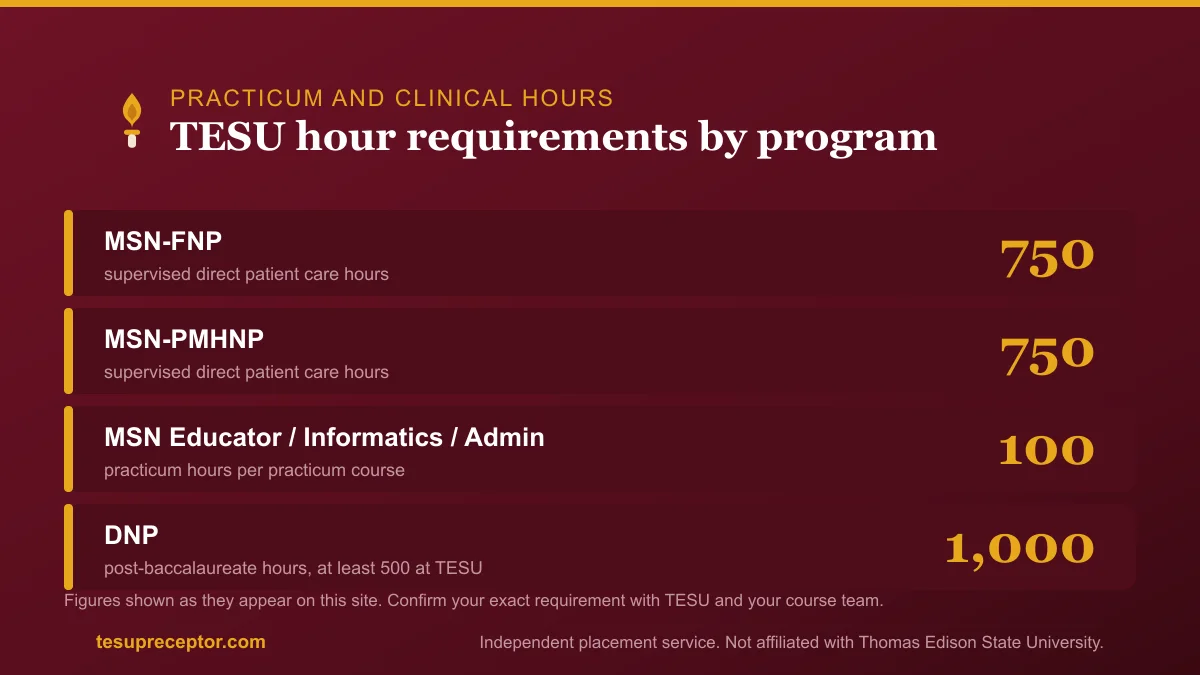
How many practicum hours does each TESU nursing program require?
The short answer is in the table below: FNP 750 clinical hours, one required 100-hour NUR-7510 practicum for each MSN specialization, and DNP a minimum of 1,000 hours with at least 500 at TESU. The MSN-PMHNP and Post-Master's PMHNP certificate each publish 750 supervised direct-patient-care hours.
| Program | Practicum or clinical hours | Preceptor required |
|---|---|---|
| MSN-FNP | 750 clinical hours | Yes |
| MSN-PMHNP | 750 direct-patient-care hours; one-on-one clinical components with limited approved telemedicine | Yes |
| Post-Master's PMHNP certificate | 750 supervised direct-patient-care hours | Yes |
| MSN Nurse Educator | one required 100-hour NUR-7510 practicum in the current catalog | Yes |
| MSN Nursing Informatics | one required 100-hour NUR-7510 practicum in the current catalog | Yes |
| MSN Nursing Administration | one required 100-hour NUR-7510 practicum in the current catalog | Yes |
| DNP (Systems-Level Leadership) | Minimum 1,000 post-baccalaureate hours, at least 500 at TESU | Yes |
How many clinical hours does the TESU MSN-FNP require?
The MSN-FNP requires 750 clinical hours, completed under a qualified preceptor at an approved site. The program is 44 credits across 14 courses and is delivered online, but the clinical hours are hands-on and cannot be done remotely.
Because 750 hours is a substantial commitment for a working RN, the hard part is not the number itself, it is securing a preceptor whose license and certification match the family-practice population and who can host you across enough shifts to reach the total. That is the search where most FNP students stall.
You must carry malpractice insurance before you register for the practicum courses that carry these hours, so plan for that alongside your placement.
What are the PMHNP hour requirements at TESU?
The MSN-PMHNP is a 46-credit, 13-course program with 750 direct-patient-care hours across six 125-hour practicum components. TESU describes one-on-one, in-person clinical components and permits limited approved telemedicine under its current practicum guide.
The Post-Master's PMHNP certificate is a 31-credit online direct-care NP certificate with 750 supervised direct-patient-care hours. The post-graduate APRN certificate is pursuing initial CCNE accreditation, so verify its current status before relying on it.
One accreditation note to keep straight: the Post-Graduate APRN certificate is pursuing initial CCNE accreditation and is not yet accredited. If you are looking at that certificate, confirm its current accreditation status with TESU, and do not assume it is accredited.
How many practicum hours do the MSN specializations require?
Each of the three MSN specializations currently includes one required 100-hour NUR-7510 practicum in the current catalog. These are the indirect-care tracks, Nurse Educator, Nursing Informatics, and Nursing Administration, and they are 30-credit online programs. They are not nurse practitioner tracks.
The specializations carry an extra planning layer: for each practicum course you arrange the preceptor, the site, and an approvable project. That project requirement is easy to underestimate, because a willing preceptor is not enough on its own; the work you do during the 100 hours has to be a project the program will approve.
This is exactly where we help specialization students, by sourcing a preceptor and site whose setting can actually support an approvable project, not just a signature.
How many hours does the TESU DNP require, and how many must be at TESU?
The DNP (Systems-Level Leadership) requires a minimum of 1,000 post-baccalaureate clinical or practicum hours, and at least 500 of those must be completed at TESU. The program is online, and the leadership focus shapes the kind of site and preceptor that will count.
If you already banked hours during a prior graduate program, the post-baccalaureate framing matters, because those earlier hours may apply toward the 1,000 total while the 500-at-TESU floor still stands. Confirm exactly how your prior hours are counted with TESU, since that determination is theirs to make.
For DNP students, the sourcing challenge is finding a systems-level or leadership setting and a preceptor positioned to sign off on that scope of work, which is narrower than a general clinical placement.
Good to know
Which TESU program has the most clinical hours?
Of the published totals, the DNP is highest at a minimum of 1,000 post-baccalaureate hours (at least 500 at TESU), followed by the MSN-FNP at 750 clinical hours. The MSN specializations currently include one required 100-hour NUR-7510 practicum in the current catalog. The MSN-PMHNP and Post-Master's PMHNP certificate each publish 750 supervised direct-patient-care hours.
Do the MSN specialization hours repeat for each practicum course?
Yes. The current catalog lists one required 100-hour NUR-7510 practicum for each specialization. The student identifies a candidate preceptor, site, and project for TESU review. Follow the active catalog and degree audit because one public FAQ describes two practicums.
Can I complete all my DNP hours somewhere other than TESU?
No. The DNP requires a minimum of 1,000 post-baccalaureate hours, and at least 500 of them must be completed at TESU. Confirm how any prior post-baccalaureate hours are counted directly with TESU.
How many clinical hours does TESU PMHNP require?
TESU now publishes 750 direct-patient-care hours for the MSN-PMHNP. Use the current catalog and practicum guide for the six 125-hour clinical components and the limited PMHNP telemedicine rule.
Do I need malpractice insurance for these practicum hours?
Yes. TESU requires you to carry malpractice insurance before you register for practicum courses, across these programs. It is a quick, low-cost step for students, and you should have proof ready when you submit your placement for approval.
Related
Do not let the search cost you a term
Tell us your TESU program, your city, and your practicum timeline. We will come back with a placement plan and a realistic path to a preceptor and your clinical hours.