Secure a Preceptor for the TESU MSN-FNP 750-Hour Program
To finish the Thomas Edison State University MSN-FNP, you need an approvable family or primary-care preceptor to supervise 750 clinical hours, and lining that person up is the single hardest, most time-consuming step for a working RN. We are an independent placement service, separate from TESU or CCNE, and we source, vet, and coordinate a family nurse practitioner or primary-care physician preceptor and site that fit your term, so you can register your practicum courses on schedule instead of cold-calling clinics for months.
Tell us your program and city. It is free to ask, with no obligation.
How many clinical hours does the TESU MSN-FNP require?
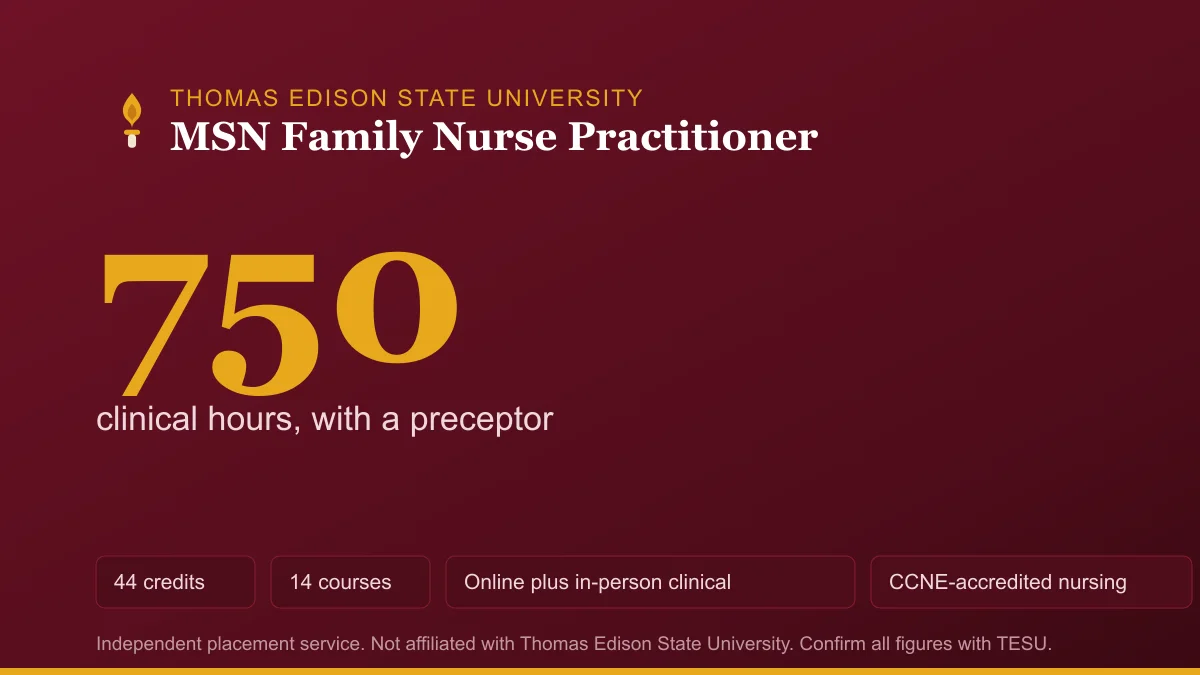
The TESU MSN-FNP requires 750 clinical hours, all of which must be completed under an approved preceptor at an approved site. The Family Nurse Practitioner track through the W. Cary Edwards School of Nursing and Health Professions is delivered online and spans 44 credits across 14 courses, but the didactic coursework is not what stalls most students. The clinical portion is. Those 750 hours cannot begin until you have a preceptor and a site in place and your paperwork approved, which is why the preceptor search, not the reading and exams, is where working nurses most often lose a term.
| TESU MSN-FNP fact | Detail |
|---|---|
| Required clinical hours | 750 |
| Credits | 44 |
| Courses | 14 |
| Format | Online coursework, in-person clinical |
| Preceptor required | Yes |
| Nursing accreditor | CCNE |
Because the number is fixed at 750, there is no shortcut on the total. What you can change is how quickly and reliably you get a qualified preceptor confirmed so those hours actually start when your term does.
What kind of preceptor does the FNP track need?
The TESU MSN-FNP needs a preceptor who practices in family or primary care and who is licensed and credentialed to supervise a nurse practitioner student, which usually means a board-certified family nurse practitioner, a primary-care physician, or a comparable qualified provider practicing in a family or primary-care setting. The point of the 750 hours is broad, family-focused primary care across the lifespan, so the preceptor and the site have to reflect that scope rather than a narrow subspecialty.
In practice this means a family practice, a community primary-care clinic, an internal medicine or pediatrics office, a federally qualified health center, or a similar outpatient setting where you will see the range of ages and conditions the program expects. TESU has its own criteria for who and what it will approve, and those criteria are what we screen against before we ever put a preceptor in front of you, so you are not chasing someone the university will later reject.
We confirm the preceptor's license, certification, and scope, and we confirm the site can support the volume and variety of patients your 750 hours require. A preceptor who is willing but wrong for the track wastes weeks, so verification comes first, not after a handshake.
Why is finding an FNP preceptor so hard for working nurses?
Finding an FNP preceptor is hard because you are asking a busy clinician to take on an unpaid teaching commitment, on top of a full patient panel, for hundreds of hours, and most working nurses have to run that search alone while still holding down a job. It is not that a preceptor is impossible to find. It is that the search is unstructured, competitive, and slow.
- Practices are approached by many students at once and often decline simply because they are at capacity.
- A provider who says yes may not meet the university's criteria, or the site may not, so the approval falls through late.
- Credentialing, site agreements, and documentation take time you do not have while working clinical shifts.
- Malpractice insurance must be in place before you register for practicum courses, adding another deadline to the pile.
The exact policy on who is responsible for securing the preceptor is something you should confirm directly with TESU, and we do not claim the university refuses to help. What we can tell you plainly is that, in practice, the burden of actually lining up an approvable preceptor tends to land on the student, and that is exactly the burden we exist to carry.
What do we do to secure your FNP placement?
We source, vet, and coordinate a qualified family or primary-care preceptor and site for your 750 TESU FNP hours, and we manage the logistics that usually eat a working nurse's evenings. Our fee covers that sourcing, verification, and coordination work. It is never a payment to the preceptor, because preceptors are not paid by us.
- We identify family and primary-care preceptors near you who have capacity for your term.
- We verify license, certification, and scope against the program's requirements before presenting anyone.
- We confirm the site can support the patient variety and volume your 750 hours need.
- We help you assemble and track the placement paperwork so approvals do not stall.
- We remind you that malpractice insurance must be active before you register for practicum courses.
We are an independent service that works separately from TESU or CCNE. We do not enroll you, grade you, or speak for the university. What we do is remove the placement bottleneck so your clinical term starts on time and your 750 hours count.
When should you start the preceptor search?
Start the preceptor search well before your practicum term, because sourcing, verifying, and getting a site approved routinely takes longer than students expect. A preceptor confirmed the week before registration is the exception, not the rule, and a rushed search is how a term gets pushed.
Give yourself a runway of at least a few months ahead of the term you want the 750 hours to begin. That window absorbs the normal delays: a first-choice practice at capacity, a credentialing step that takes longer than promised, or a site agreement waiting on signatures. Starting early also means your malpractice insurance can be in place before registration without a last-minute scramble. The earlier you hand the search off, the more likely your clinical hours start exactly when your term does.
Good to know
How many clinical hours does the TESU MSN-FNP require?
The TESU MSN-FNP requires 750 clinical hours under an approved preceptor at an approved site. The program is 44 credits across 14 courses, delivered online, with the clinical hours completed in person.
Do you pay the preceptor to take me?
No. Preceptors are not paid by us, and our fee never goes to the preceptor. Our fee covers sourcing, verifying, and coordinating a qualified family or primary-care preceptor and site for your placement.
Are you affiliated with Thomas Edison State University?
No. We are an independent placement service that works separately from TESU or CCNE. We help you secure and verify a preceptor, but the university handles enrollment, approval, and grading.
What type of preceptor qualifies for the FNP track?
A preceptor practicing in family or primary care who is licensed and credentialed to supervise an NP student, such as a board-certified family nurse practitioner or a primary-care physician. We verify license, certification, scope, and the site against the program's criteria before presenting anyone.
Do I need malpractice insurance before starting?
Yes. Students must carry malpractice insurance before registering for practicum courses. We flag this early so it is in place before your registration deadline rather than becoming a last-minute obstacle.
Do not let the search cost you a term
Tell us your TESU program, your city, and your practicum timeline. We will come back with a placement plan and a realistic path to a preceptor and your clinical hours.