Build a TESU nursing placement plan in Indiana
Indiana is a Reduced Practice state, and TESU currently lists its NP, non-NP MSN, and DNP pathways as available there. An Indianapolis placement still requires the student to identify candidates and complete TESU and site review before any hours begin.
Tell us your program and city. It is free to ask, with no obligation.
Start the Indiana file with program access
An Indianapolis student can begin with TESU's current disclosure showing NP, non-NP MSN, and DNP pathways available in Indiana. That program status is only the first checkpoint. The individual clinician, organization, schedule, course objectives, and required agreements must still survive review.
TESU assigns the first sourcing step to the out-of-state student: identify a prospective preceptor and site. Advisors and nursing administrators can collaborate, and TESU staff verify the final proposal. Near Fort Wayne, keep every contact described as a prospect until that verification is finished.
Keep TESU connected to the Indianapolis organization
Turn a Fort Wayne lead into a complete candidate file before TESU review. Align the student's course and dates with the preceptor resume, Board record, physical site, schedule, and organization contact. The authorized representative must be able to approve access and participate in any required agreement process.
TESU allows third-party vendors in the sourcing stage, including a search for physical Indianapolis prospects. The university still communicates directly with the proposed preceptor and site representative for review. We can organize candidate facts, but cannot promise that TESU will approve the person, organization, schedule, or hours.
Treat Indianapolis and Fort Wayne as separate markets
Indianapolis offers the broadest mix of systems, ambulatory groups, academic settings, community organizations, and administrative departments. Fort Wayne, Evansville, South Bend, Mishawaka, Lafayette, Bloomington, Terre Haute, and the northwest Indiana corridor provide additional markets. A site near a city name may still be far from the student's home or workplace, so calculate the repeated trip.
For an Indianapolis-centered search, name the enrolled course, term dates, weekly availability, patient population or project access, and organization contact route. A clinician's interest cannot grant access to patients, records, classrooms, leadership meetings, or project data without site authorization. Test travel at the hour the student would actually attend.
Use the student's repeatable week to rank the Indianapolis and Fort Wayne options alongside prospects in Evansville, South Bend, and Lafayette. Record available days, shift length, travel time, course objective, needed population or project access, and the organization contact for every lead. That local matrix makes it easier to drop an impractical prospect before the clinician and site invest time in a TESU review.
Use Indiana licensing facts in screening
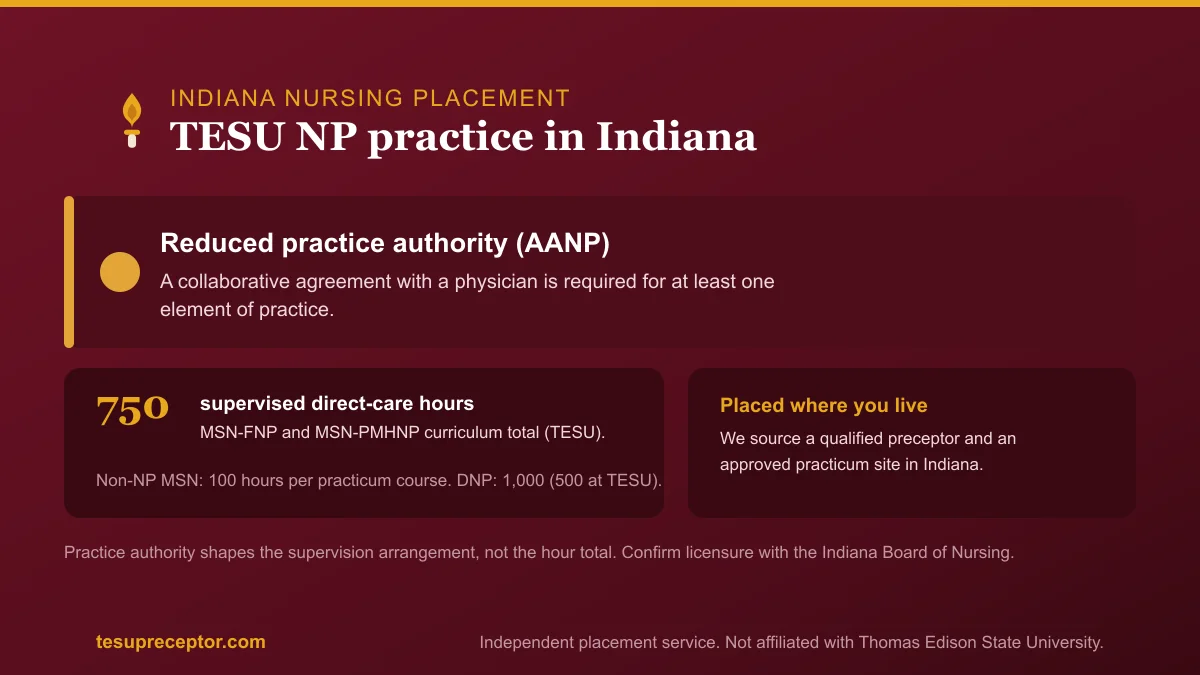
The Reduced Practice category applies in Indiana. A clinician near Fort Wayne may face a state limitation on at least one element of NP care or a required regulated relationship. Candidate screening should record that arrangement alongside TESU supervision, course scope, and organization policy.
Before presenting an Indianapolis clinician, verify the published record through the Indiana State Board of Nursing. Confirm identity, current status, advanced practice designation, population preparation, and public restrictions. Keep a dated result because organization webpages can be incomplete or stale.
Keep Indiana hour totals pathway-specific
TESU publishes 750 clinical hours for FNP and 750 practicum hours for PMHNP. An Indianapolis site must be assessed against the course currently approaching, not only the program total. Primary care population and activity matter for FNP; psychiatric mental health scope, patient access, and supervision matter for PMHNP.
The hour conversation changes for non-NP pathways. Each non-NP MSN specialty has a 100-hour practicum course, while TESU's DNP requires 1,000 post-BSN supervised practice hours, including at least 500 through TESU. An Indianapolis organization should receive the project or practicum objective that actually applies.
Keep physical sourcing central around Indianapolis
TESU's 2025-2026 practicum guide permits PMHNP telemedicine sessions with an approved preceptor as a specialty placement, remotely or within a site, when all required approvals are in place. No more than 50% of total practicum hours in each 8-week term may use telemedicine. For an Indianapolis-connected proposal, the governing state is where patients are physically located.
Physical candidate sourcing is the placement focus around Fort Wayne. A PMHNP telemedicine component must be documented separately with written TESU, course, site, and state approvals, plus patient-location, licensure, privacy, technology, and supervision details. It remains a proposal until the university acts.
Turn the Indianapolis plan into a sourcing brief
Trusted by nursing students and working nurses. A useful Indiana intake names the TESU pathway, course, term, required hours, weekly availability, physical city, travel radius, setting or project need, RN license state, and any approved PMHNP telemedicine component. Those facts let the search start with a realistic Indianapolis profile.
Submit the course details through a free placement review for the Fort Wayne area. We can test the physical search and show a proposed match before payment; payment is due only when matched. The university and organization still decide whether the arrangement may proceed.
Good to know
What should a TESU student confirm before contacting an Indianapolis preceptor?
For the Indianapolis search, confirm current program availability, active admission, the exact course, term, physical site state, candidate role, schedule, and organization process. The Indianapolis clinician remains a prospect until TESU and the site complete review.
How does AANP classify nurse practitioner practice around Indianapolis in Indiana?
AANP classifies Indiana as reduced practice. That category describes licensed NP authority; it does not approve a TESU student, preceptor, site, schedule, patient population, or course around Indianapolis.
Which TESU hour totals matter for a placement near Fort Wayne?
For the Fort Wayne plan, TESU publishes 750 clinical hours for FNP, 750 practicum hours for PMHNP, a 100-hour practicum course in each non-NP MSN specialty, and 1,000 post-BSN DNP hours with at least 500 completed at TESU.
How is PMHNP telemedicine limited for an Indianapolis-connected term?
With all approvals for the Indianapolis plan, telemedicine may cover no more than 50% of each 8-week term. For Indianapolis, the applicable state follows where patients are physically located, and written TESU, course, site, and state permission is required.
Do not let the search cost you a term
Tell us your TESU program, your city, and your practicum timeline. We will come back with a placement plan and a realistic path to a preceptor and your clinical hours.