Build a TESU nursing placement plan in Kansas
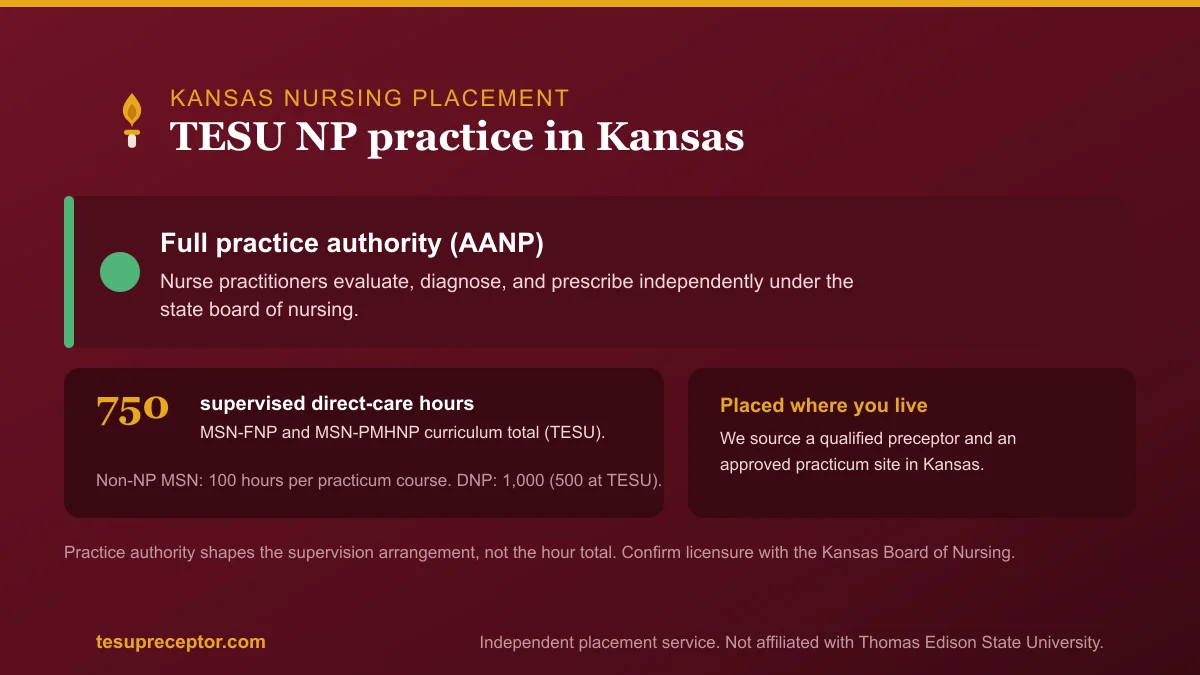
Kansas is a Full Practice state, and TESU currently lists its nurse practitioner programs as not available there. Non-NP MSN and DNP pathways remain available in Kansas, subject to the enrolled course, candidate, site, and university review.
Tell us your program and city. It is free to ask, with no obligation.
Confirm Kansas eligibility before outreach
TESU program eligibility comes before a Wichita clinician search. The university currently lists FNP and PMHNP study as not available in Kansas, so an NP candidate should not be asked to reserve dates unless TESU issues a new written determination for that student and cohort. The AANP category and a valid license do not change the academic restriction.
The restriction is limited to NP study, not every TESU nursing pathway. A student near Topeka may still plan the non-NP MSN 100-hour practicum course, and a DNP learner may pursue approved systems-level practice and project activity. The exact course and current TESU instructions should lead every conversation with an organization.
Build a repeatable route from Wichita
Wichita contains Kansas's broadest central mix of systems, clinics, universities, community programs, and administrative departments. Topeka and Lawrence form another corridor, while the Kansas side of the Kansas City region offers a different pool. Salina, Manhattan, Hays, and Garden City can support regional searches, but rural travel must fit the term schedule.
Build the Kansas outreach brief around the course activity rather than a generic need for hours. A Wichita clinic, a Topeka leadership department, an academic setting, and a community program answer different objectives and follow different approval routes. Record the physical address before widening the radius.
A workable Kansas search also separates clinician fit from organization capacity. The preceptor may have the right background while the Wichita site lacks room, patient mix, project access, or an authorized signer. Track Topeka separately from Lawrence, Salina, and Hays, then compare each schedule and commute with the entire term rather than a single introductory meeting.
Read Kansas authority through the Board record
AANP categorizes Kansas as Full Practice. For an NP around Wichita, state law generally permits evaluation, diagnosis, ordering and interpreting tests, treatment, and prescribing within education, certification, and licensure. A TESU student still performs only supervised course activity approved by the site and university.
Use the Kansas State Board of Nursing as the primary credential source for a Topeka candidate. Match the legal name, active status, role, population focus, and public conditions to the resume and organization. A directory profile is not a substitute for the Board result.
Apply TESU hours to the Wichita setting
For TESU planning around Wichita, FNP carries 750 clinical hours and PMHNP carries 750 practicum hours. Those are pathway totals, not a generic target for every nursing student. A candidate should see the upcoming course objectives and expected patient access before discussing capacity.
A non-NP MSN request near Topeka should be framed as the 100-hour practicum course, not as an NP clinical total. For DNP, TESU requires 1,000 post-BSN supervised practice hours and at least 500 at TESU. Any earlier graduate hours remain subject to verification before the student builds the remaining plan.
Move the Kansas candidate into TESU review
After the student identifies a preceptor and site candidate in Kansas, assemble the current TESU placement materials. The Wichita file may require resumes, license information, the course and schedule, the physical organization address, and confirmation from an authorized site representative. Hours should not begin while required reviews or agreements remain open.
A third-party vendor may help a student find a practicum prospect near Topeka. Academic review remains direct: TESU communicates directly with the candidate and authorized organization representative. Our role is physical sourcing and candidate preparation, while the student submits the file and TESU decides whether the arrangement is acceptable. No approval is guaranteed.
Apply the patient-location rule in Kansas
The PMHNP telemedicine rule is term-specific for the Wichita plan. With an approved preceptor and all permissions, TESU's 2025-2026 guide allows sessions remotely or at a site, capped at 50% of total practicum hours during each 8-week term. For a proposal in Kansas, identify the physical location of every patient population before applying state rules.
Because NP study is not currently available in Kansas, telemedicine cannot create a PMHNP exception. Physical sourcing can address eligible non-NP MSN and DNP work around Topeka. Only a new written TESU determination for the exact course, site, state, and student could reopen an NP proposal, and it would still receive full review.
Bring a complete Kansas request to support
Trusted by nursing students and working nurses. The strongest Kansas request includes the pathway, course objectives, term, hour need, schedule, physical location, commute, patient population or project access, license state, and written approval details. That information turns a broad Topeka search into a testable placement brief.
For an eligible non-NP MSN or DNP course, request a free placement review of the Wichita market and approval path. Students can inspect a proposed match before payment and pay only when matched. FNP or PMHNP sourcing waits for a new written TESU eligibility decision.
Good to know
What should a TESU student confirm before contacting a Wichita preceptor?
TESU currently lists NP study as not available in Kansas. A Wichita NP search needs a new written eligibility decision first; available non-NP MSN and DNP requests still require the exact course and approval route.
How does AANP classify nurse practitioner practice around Wichita in Kansas?
AANP classifies Kansas as full practice. That category describes licensed NP authority; it does not approve a TESU student, preceptor, site, schedule, patient population, or course around Wichita.
Which TESU hour totals matter for a placement near Topeka?
For the Topeka plan, TESU publishes 750 clinical hours for FNP, 750 practicum hours for PMHNP, a 100-hour practicum course in each non-NP MSN specialty, and 1,000 post-BSN DNP hours with at least 500 completed at TESU.
How is PMHNP telemedicine limited for a Wichita-connected term?
With all approvals for the Wichita plan, telemedicine may cover no more than 50% of each 8-week term. For Wichita, the applicable state follows where patients are physically located, and written TESU, course, site, and state permission is required.
Do not let the search cost you a term
Tell us your TESU program, your city, and your practicum timeline. We will come back with a placement plan and a realistic path to a preceptor and your clinical hours.