Build a TESU nursing placement plan in Louisiana
Louisiana is a Reduced Practice state, and TESU currently lists its nurse practitioner programs as not available there. Non-NP MSN and DNP pathways remain available in Louisiana, subject to the enrolled course, candidate, site, and university review.
Tell us your program and city. It is free to ask, with no obligation.
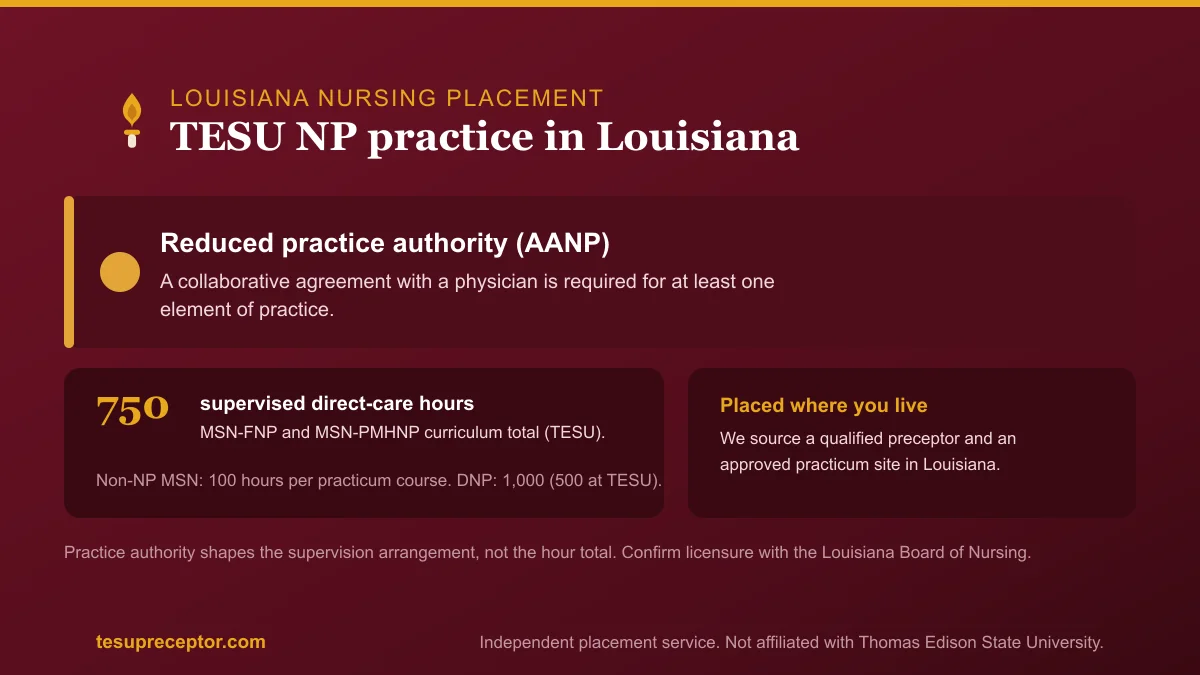
What the AANP category means in Louisiana
AANP categorizes Louisiana as Reduced Practice because at least one NP function is limited or tied to a regulated relationship. Around New Orleans, ask how the candidate lawfully practices and who holds any related responsibility. The answer informs review but never substitutes for TESU approval.
Search the Louisiana State Board of Nursing under the candidate's legal name. For a New Orleans prospect, save the active credential, advanced practice role, population focus, expiration information, and any public conditions. An employer biography can describe experience, but the official Board record should anchor the license check.
Use the right TESU requirement in Louisiana
Keep the two NP totals separate in the Baton Rouge brief: TESU lists 750 clinical hours for FNP and 750 practicum hours for PMHNP. The total does not prove that one clinician can cover every term. Each course needs its own schedule, population, setting, and supervision review.
TESU's non-NP MSN specialties each include a 100-hour practicum course. The DNP requires 1,000 post-BSN supervised practice hours, with at least 500 completed at TESU; prior graduate hours count only after university verification. A New Orleans DNP request also needs a suitable project setting and the current university process.
Turn Louisiana geography into a weekly plan
New Orleans and Jefferson Parish offer large health systems, community organizations, academic settings, and specialty departments. Baton Rouge adds state, public health, hospital, education, and administrative possibilities. Shreveport and Bossier City form the principal northwestern market, while Monroe can anchor a northeastern search.
Treat New Orleans and Baton Rouge as separate commute decisions. Give each prospective organization the TESU pathway, exact course, dates, weekly schedule, and needed access. The preceptor and site are a combined decision because a clinician cannot independently approve the organization's patients, records, staff, or project resources.
Screen the weekly pattern before expanding beyond New Orleans. Ask how many days the student can attend, whether shifts are fixed, and which course activities require direct access. Baton Rouge and communities such as Shreveport, Lafayette, and Monroe may add candidates, but they also change travel, organization contacts, and the physical site state. Keep those facts beside each lead so convenience never gets confused with academic fit.
Which TESU pathways can use a site in Louisiana?
For Louisiana, settle the TESU pathway before outreach. Current university disclosures mark the nurse practitioner programs as not available, which means a New Orleans FNP or PMHNP prospect should not be approached for dates. State practice authority answers a licensing question, not TESU eligibility.
TESU's non-NP MSN specialties and DNP remain available in Louisiana, subject to review. A Baton Rouge contact needs the actual course and activity, not a generic request for clinical hours. The MSN practicum may require a 100-hour course plan, while DNP work also depends on project access and the university process.
Use the PMHNP term cap correctly in Louisiana
For PMHNP only, TESU's 2025-2026 guide describes approved telemedicine sessions as a possible specialty placement, either remote or within a site. All approvals still apply, and telemedicine may account for no more than 50% of each 8-week term. The Baton Rouge student's home address does not control; use the patient's physical state.
The telemedicine provision does not override TESU's NP restriction in Louisiana. Placement support remains focused on physical non-NP MSN and DNP candidates near New Orleans. An NP format question requires a new written TESU decision covering the course, site, patient state, licenses, supervision, privacy, and organization authority before academic credit could be considered.
From New Orleans prospect to reviewable placement
A verbal yes from a New Orleans clinician starts documentation, not attendance. The student should prepare the current TESU materials, identify the physical site and authorized representative, and provide the candidate's resume and credential details. TESU and the organization decide what additional review or agreement is necessary.
TESU permits third-party vendors to help locate practicum placements, but the university communicates directly with the prospective preceptor and authorized site representative. We can source physical candidates around New Orleans, organize public credential facts, and clarify the brief. The student submits the proposal, and neither a vendor nor an interested clinician can guarantee TESU approval or countable hours.
Request a focused review for New Orleans
Trusted by nursing students and working nurses. For a New Orleans search, provide the TESU program, exact course, dates, hours, weekly schedule, physical address range, travel limit, required setting or project access, and current university instructions. A complete brief prevents avoidable calls to unsuitable Louisiana candidates.
Submit a free placement review for an eligible non-NP MSN or DNP placement around New Orleans. We can assess the physical market, timing, and candidate profile before payment; students pay only when matched. The current TESU restriction prevents an NP search unless eligibility changes in writing.
Good to know
What should a TESU student confirm before contacting a New Orleans preceptor?
TESU currently lists NP study as not available in Louisiana. A New Orleans NP search needs a new written eligibility decision first; available non-NP MSN and DNP requests still require the exact course and approval route.
How does AANP classify nurse practitioner practice around New Orleans in Louisiana?
AANP classifies Louisiana as reduced practice. That category describes licensed NP authority; it does not approve a TESU student, preceptor, site, schedule, patient population, or course around New Orleans.
Which TESU hour totals matter for a placement near Baton Rouge?
For the Baton Rouge plan, TESU publishes 750 clinical hours for FNP, 750 practicum hours for PMHNP, a 100-hour practicum course in each non-NP MSN specialty, and 1,000 post-BSN DNP hours with at least 500 completed at TESU.
How is PMHNP telemedicine limited for a New Orleans-connected term?
With all approvals for the New Orleans plan, telemedicine may cover no more than 50% of each 8-week term. For New Orleans, the applicable state follows where patients are physically located, and written TESU, course, site, and state permission is required.
Do not let the search cost you a term
Tell us your TESU program, your city, and your practicum timeline. We will come back with a placement plan and a realistic path to a preceptor and your clinical hours.