Plan an Eligible TESU Nursing Practicum in Oregon
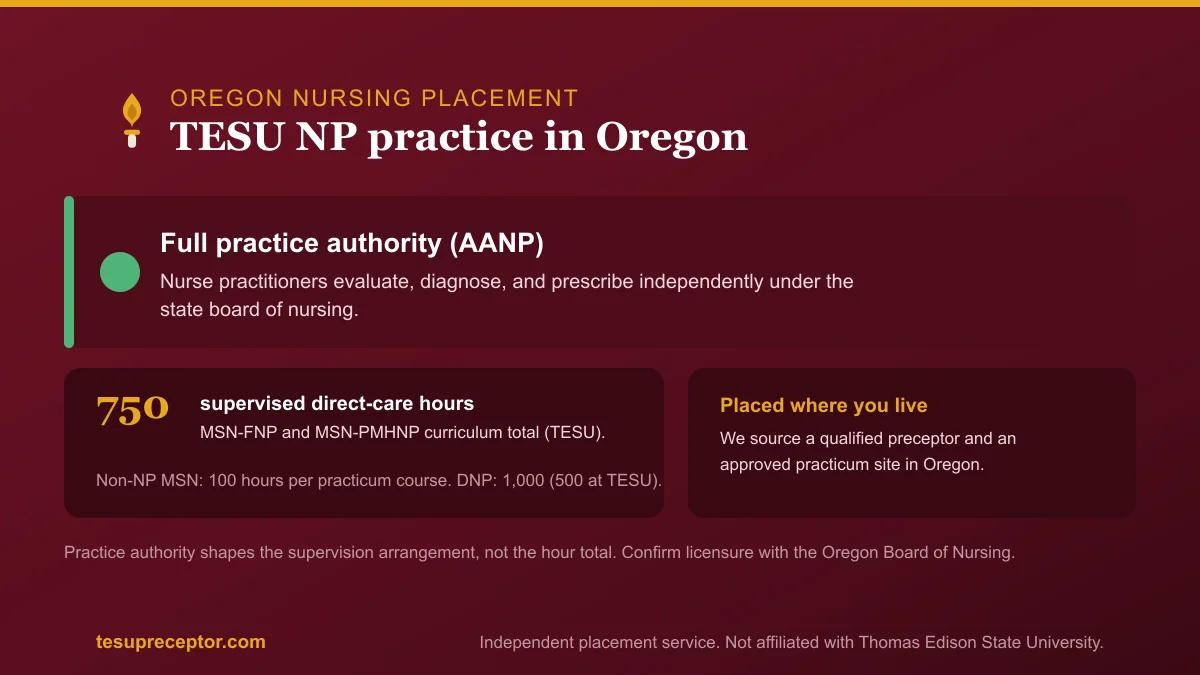
AANP classifies Oregon as Full Practice, which describes licensed NP authority across the Portland and Bend divide. TESU currently restricts NP study in Oregon.
Tell us your program and city. It is free to ask, with no obligation.
Use the Oregon Board record, not assumptions
An NP search in the Portland and Bend divide stops first at TESU eligibility: TESU currently restricts NP study in Oregon. Practitioner interest and state practice authority do not create an exception to the current disclosure.
Non-NP MSN specialties and the DNP remain open to case-by-case planning under the current table. Around the Portland and Bend divide, start with the enrolled course and project or practicum duties, then confirm the organization can authorize the required access.
Start with Oregon program eligibility
For Oregon, the first screening fact is TESU's current NP restriction. An open clinic or interested practitioner cannot change the university's program-availability decision. That requirement remains active across the Portland and Bend divide.
TESU still lists the non-NP MSN pathways and DNP as available in Oregon, subject to individual review. Nurse Educator, Nursing Informatics, or Nursing Administration students can plan the practicum attached to their active degree plan, and DNP students can develop an approved project setting. If TESU later changes NP availability, obtain that determination in writing for the exact student, program, and cohort before a placement commitment. That checkpoint is applied through the Portland and Bend divide.
Course fit matters as much as the published hours
The published MSN-FNP total is 750 supervised direct patient care hours, and MSN-PMHNP also carries 750 supervised direct patient care hours. Candidate screening across the Portland and Bend divide happens term by term because patient mix and objectives change through the sequence. These published totals do not override the current TESU NP restriction in Oregon.
Nurse Educator, Nursing Informatics, and Nursing Administration currently share one required 100-hour NUR-7510 practicum, delivered as on-ground supervised experiential work with a project. Since the FAQ says two practicums, verify the student's catalog and degree audit before searching the Portland and Bend divide. DNP planning uses at least 1,000 supervised post-BSN hours, including at least 500 completed at TESU.
Build a regional Oregon prospect list
Portland and its Washington County and Clackamas County suburbs contain Oregon's largest clinical market. Salem, Eugene, Springfield, Corvallis, Bend, Medford, and Grants Pass add regional centers, while coast and eastern Oregon searches may depend on smaller organizations.
Mountain passes, winter weather, and the distance between western and eastern Oregon make a broad statewide search impractical. For non-NP MSN or DNP work, define the student's travel corridor and the organization's approval process before treating a prospect as viable. Turn the Oregon search into a practical schedule by stating the course, calendar, setting, required experiences, available days, and sustainable travel limit.
Treat DNP sourcing as project-site development
For DNP planning in Oregon, connect the mentor and organization to a defined systems-level quality-improvement project. TESU requires CITI training and the agency's IRB approval or determination before the university IRB step; TESU approval follows NUR-9020 and is required before NUR-9120. Data access and organizational authority must therefore be discussed early. The workable geographic frame is the Portland and Bend divide.
Virtual-capable does not mean fully remote
PMHNP is the TESU pathway with a published telemedicine allowance. No more than 50 percent of each eight-week term, or 62.5 of 125 hours, may use it, and the preceptor must be fully present online. An encounter touching the Portland and Bend divide is governed by the state where the patient is physically sitting.
Nothing about telemedicine removes the ordinary review for the Portland and Bend divide. The student needs written TESU confirmation covering the course, site, and state, plus correct licenses, organizational consent, privacy controls, technology, and live supervision. Do not transfer the PMHNP limit to FNP, a non-NP MSN practicum, or DNP work. Telemedicine cannot bypass TESU's current NP restriction for Oregon.
Who does what after an Oregon clinician says yes
In the published TESU process, an out-of-state student brings forward Oregon candidates and the university collaborates, verifies, and makes the academic decisions. The proposed preceptor, authorized organizational representative, course team, and agreement process each have a role, so a verbal yes from one clinician is not a completed placement. That checkpoint is applied through the Portland and Bend divide.
TESU permits third-party help with candidate identification. Our role can include physical sourcing in Oregon, public credential checks, availability questions, and a clean candidate brief, while TESU deals directly with the preceptor and organization for review. No service can guarantee approval or countable hours. The Portland and Bend divide gives this requirement its practical search boundary.
What placement support needs from an Oregon student
Trusted by nursing students and working nurses. To screen the Portland and Bend divide, provide the student's program, course code, calendar, hour requirement, weekly schedule, repeatable commute, setting needs, current license state, and physical or approval-dependent PMHNP format.
A free placement review can test non-NP MSN or DNP fit around the Portland and Bend divide, including timing and host type. Matching follows the student's review, with payment only after a match. Current NP restrictions remain in force unless TESU changes the individual student's status in writing.
Good to know
What AANP practice category applies in Oregon?
AANP places Oregon in full practice. That classification describes licensed NP authority across the Portland and Bend divide; it does not expand a TESU student's supervised role or replace Board, site, course, preceptor, and university review.
What clinical-hour totals apply to TESU nursing students in Oregon?
TESU requires 750 direct patient care hours for FNP and 750 for PMHNP, including for work centered on the Portland and Bend divide. Current non-NP MSN pages show one 100-hour NUR-7510 on-ground practicum plus a project, subject to the active degree audit, including for work centered on the Portland and Bend divide. A DNP plan using the Portland and Bend divide needs at least 1,000 supervised post-BSN hours, with at least 500 completed at TESU.
Can a TESU PMHNP student use telemedicine involving Oregon?
PMHNP telemedicine is capped at 50 percent of each eight-week term, or 62.5 of 125 hours, with the preceptor in full virtual presence, including for work centered on the Portland and Bend divide. For the Portland and Bend divide, patient physical location controls the state review, and written TESU, course, site, state, licensure, and host approvals are required.
Can a TESU FNP or PMHNP student currently complete practicum in Oregon?
No under the current disclosure. TESU currently restricts NP study in Oregon. A clinician from the Portland and Bend divide should not be asked to commit unless the university issues a written change for the exact student, program, and cohort; non-NP MSN and DNP review remains possible.
Do not let the search cost you a term
Tell us your TESU program, your city, and your practicum timeline. We will come back with a placement plan and a realistic path to a preceptor and your clinical hours.