Plan an Eligible TESU Nursing Practicum in South Dakota
AANP classifies South Dakota as Full Practice, which describes licensed NP authority across the Sioux Falls and Rapid City divide. TESU currently restricts NP study in South Dakota.
Tell us your program and city. It is free to ask, with no obligation.
The current TESU boundary for South Dakota
TESU currently restricts NP study in South Dakota. A legally practicing clinician in the Sioux Falls and Rapid City divide cannot change that university decision, so FNP and PMHNP sourcing should wait for a written update tied to the student and cohort.
The university still permits individual review of non-NP MSN and DNP study in South Dakota. The Sioux Falls and Rapid City divide can therefore be searched for Nurse Educator, Nursing Informatics, Nursing Administration, or an approved systems-level DNP project when the active course and degree audit support it.
Read South Dakota practice authority in the student context
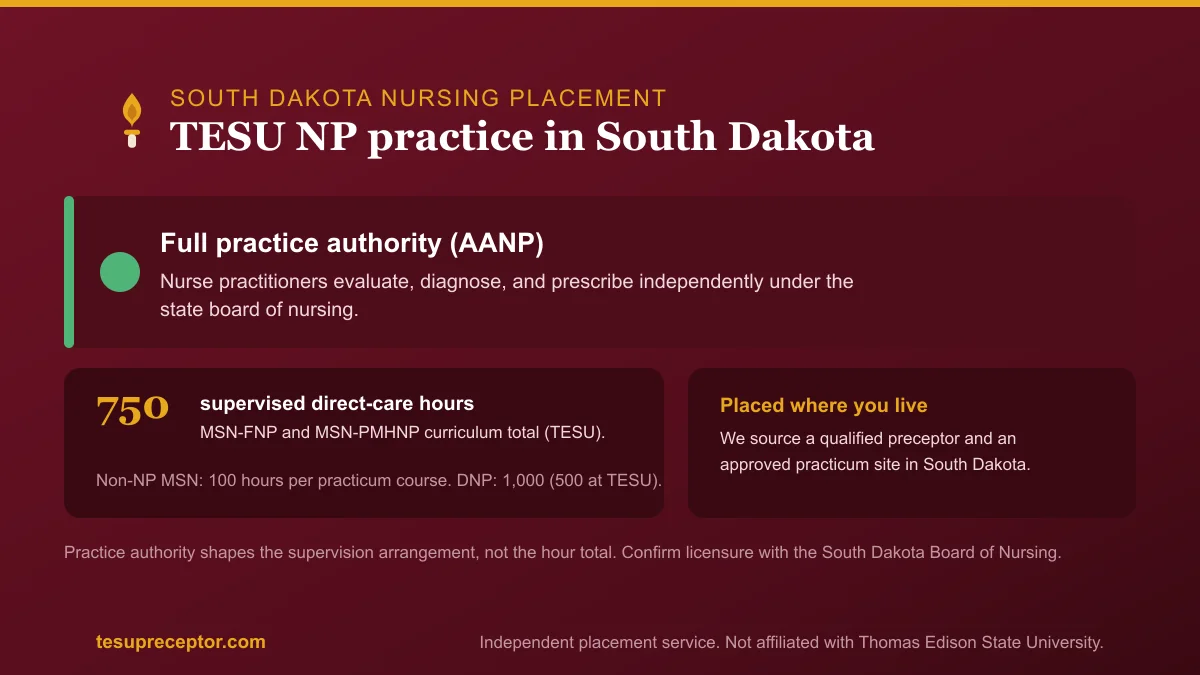
AANP classifies South Dakota as a Full Practice state. The category describes the authority available to a properly licensed NP to evaluate, diagnose, order and interpret tests, initiate treatment, and prescribe under the state nursing board's framework. That category applies to licensed professionals, not to a TESU student acting in a supervised educational role in South Dakota. That requirement remains active across the Sioux Falls and Rapid City divide.
Use the South Dakota Department of Health Boards as the official credential source for a proposed South Dakota preceptor. Match the legal name, active license, advanced-practice role, population focus, and any public conditions to the candidate file. A clinic biography or professional profile can help with background, but it cannot replace the Board record or TESU's decision.
Search the South Dakota markets the student can actually reach
Sioux Falls contains South Dakota's largest mix of clinical and organizational settings. Rapid City anchors the west, while Aberdeen, Watertown, Brookings, Mitchell, Yankton, and Pierre can support regional non-NP MSN or DNP searches.
The distance between eastern and western South Dakota rules out a one-market strategy. A student should choose a realistic service area, allow for winter travel, and identify whether the host can support the project, leadership, informatics, or education work required by the course. A useful South Dakota outreach brief gives the course code, term dates, required population or project access, weekly clinical-day options, and the farthest repeatable drive.
Translate TESU hours into a South Dakota setting
TESU requires 750 supervised direct patient care hours for FNP. Its PMHNP program separately requires 750 supervised direct patient care hours. In the Sioux Falls and Rapid City divide, a prospect must supply the population and encounters assigned to the current course, not just enough open calendar time. These published totals do not override the current TESU NP restriction in South Dakota.
Current catalog material gives the non-NP MSN specialties one required 100-hour NUR-7510 practicum with on-ground supervision and a project. The FAQ conflicts by describing two practicums, so the active catalog and degree audit control a Sioux Falls and Rapid City divide request. TESU's DNP requires at least 1,000 supervised post-BSN hours, with at least 500 completed at TESU, plus the approved systems-level project.
Move a South Dakota prospect through TESU review
TESU expects out-of-state students to identify potential South Dakota sites and preceptors, while nursing advisors and administrators collaborate and TESU staff verify the proposal. A clinician's interest starts the review; it does not finish it. The site administrator must authorize the experience, TESU must approve the people and activities, and any required agreement must be completed before work begins. The workable geographic frame is the Sioux Falls and Rapid City divide.
A third-party placement service may help locate and screen South Dakota candidates, including physical prospects, but TESU communicates directly with the candidate and site during academic review. We can organize license, resume, schedule, setting, and contact details for the student's submission. No vendor can guarantee TESU approval or academic credit. Local screening starts with the Sioux Falls and Rapid City divide.
DNP approval follows the project in South Dakota
A TESU DNP request in South Dakota is tied to a systems-level evidence-based quality-improvement project, not a generic shadowing arrangement. The student completes CITI ethics training, seeks agency IRB approval or an agency determination first, and then follows TESU's IRB sequence after NUR-9020 and before NUR-9120. The site must grant the access needed for the approved intervention and evaluation. That requirement remains active across the Sioux Falls and Rapid City divide.
Apply the PMHNP telemedicine cap in South Dakota
TESU permits a PMHNP telemedicine component when the approved preceptor remains in full virtual presence. The cap is 50 percent of each eight-week term, equal to 62.5 of 125 hours. For patients physically located in the Sioux Falls and Rapid City divide, the patient's state controls the licensure and practice analysis.
A virtual-capable proposal from the Sioux Falls and Rapid City divide remains conditional until written TESU permission addresses the course, site, and state. Student and preceptor licenses, host authority, privacy, technology, patient access, and real-time supervision still apply. The public allowance is PMHNP-specific and offers no guarantee of approval or credit for FNP, non-NP MSN, or DNP activity. Telemedicine cannot bypass TESU's current NP restriction for South Dakota.
Bring the complete South Dakota request
Trusted by nursing students and working nurses. A usable brief for the Sioux Falls and Rapid City divide includes the TESU pathway, active course, term dates, required hours, available days, travel limit, preferred setting, license state, and whether sourcing is physical or a conditional PMHNP telemedicine request.
Use a free placement review to assess an eligible non-NP MSN or DNP need in the Sioux Falls and Rapid City divide. The student reviews the proposed match before payment and pays only when matched. FNP and PMHNP outreach must wait for a written TESU eligibility change applying to that student and cohort.
Good to know
Can a TESU FNP or PMHNP student currently complete practicum in South Dakota?
No under the current disclosure. TESU currently restricts NP study in South Dakota. A clinician from the Sioux Falls and Rapid City divide should not be asked to commit unless the university issues a written change for the exact student, program, and cohort; non-NP MSN and DNP review remains possible.
What AANP practice category applies in South Dakota?
AANP places South Dakota in full practice. That classification describes licensed NP authority across the Sioux Falls and Rapid City divide; it does not expand a TESU student's supervised role or replace Board, site, course, preceptor, and university review.
What clinical-hour totals apply to TESU nursing students in South Dakota?
TESU requires 750 direct patient care hours for FNP and 750 for PMHNP, including for work centered on the Sioux Falls and Rapid City divide. Current non-NP MSN pages show one 100-hour NUR-7510 on-ground practicum plus a project, subject to the active degree audit, including for work centered on the Sioux Falls and Rapid City divide. A DNP plan using the Sioux Falls and Rapid City divide needs at least 1,000 supervised post-BSN hours, with at least 500 completed at TESU.
Can a TESU PMHNP student use telemedicine involving South Dakota?
PMHNP telemedicine is capped at 50 percent of each eight-week term, or 62.5 of 125 hours, with the preceptor in full virtual presence, including for work centered on the Sioux Falls and Rapid City divide. For the Sioux Falls and Rapid City divide, patient physical location controls the state review, and written TESU, course, site, state, licensure, and host approvals are required.
Do not let the search cost you a term
Tell us your TESU program, your city, and your practicum timeline. We will come back with a placement plan and a realistic path to a preceptor and your clinical hours.