Build a TESU Nursing Placement Plan for Vermont
AANP classifies Vermont as Full Practice, a framework for licensed NP work across the Burlington and Rutland corridor. TESU currently lists NP study as available in Vermont, with each course, preceptor, site, and term reviewed separately, including for work centered on the Burlington and Rutland corridor.
Tell us your program and city. It is free to ask, with no obligation.
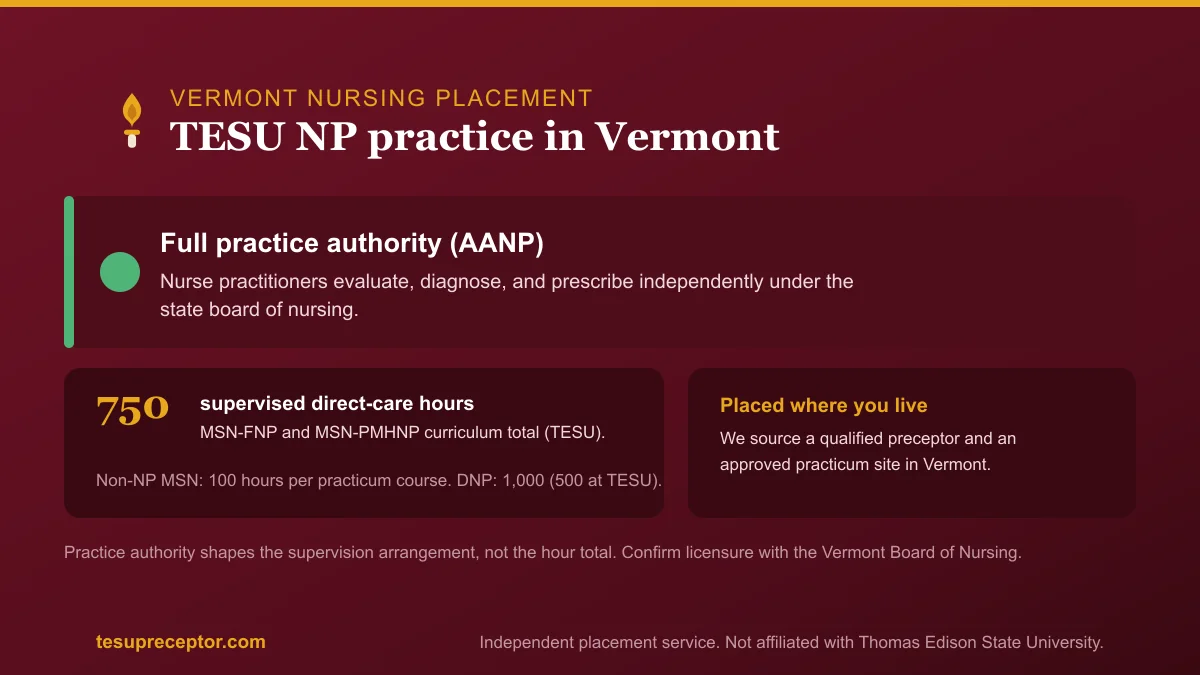
Verify authority before presenting a Vermont clinician
AANP classifies Vermont as a Full Practice state. The category describes the authority available to a properly licensed NP to evaluate, diagnose, order and interpret tests, initiate treatment, and prescribe under the state nursing board's framework. Use the category to understand the Vermont market, while keeping student authority tied to the approved learning plan.
For a Vermont prospect, verify nursing authority with the Vermont Board of Nursing. Public credential details should agree with the resume and current job, and the student's duties must remain within the approved course, site policy, and supervision plan.
A workable Vermont site starts with geography
Burlington and Chittenden County hold Vermont's largest clinical concentration. Montpelier and Barre form a central cluster, Rutland serves the south-central region, and Brattleboro, Bennington, Middlebury, St. Albans, and St. Johnsbury may suit students elsewhere.
Vermont's smaller organizations can have limited student capacity, and mountain travel changes with the season. Early outreach should identify the exact days a mentor can offer and whether the site has authority to grant access to patients, systems, staff, or project data. Screen Vermont prospects against a concise course brief that identifies dates, weekly availability, population or project needs, setting preferences, and a dependable travel radius.
Build the DNP site around the approved intervention
A Vermont DNP lead is useful only when the organization can host the planned systems-level quality-improvement project. The student completes CITI training, obtains the agency IRB decision first, and seeks TESU IRB approval after NUR-9020 and before NUR-9120. Confirm project authority, data access, and mentor role before submission. The Burlington and Rutland corridor gives this requirement its practical search boundary.
Put Vermont eligibility at the front of the search
TESU presently accepts NP planning from Vermont students. Interest from a clinician in the Burlington and Rutland corridor begins a candidate file; it does not resolve licensure, population fit, supervision, site authority, agreements, or academic acceptance.
The university also allows case-specific non-NP MSN and DNP proposals from Vermont. Across the Burlington and Rutland corridor, screen for the activity the course actually requires rather than assuming every nursing organization can host every pathway.
The Vermont request should name the exact pathway
An FNP student completes 750 supervised direct patient care hours at TESU, while a PMHNP student completes 750 supervised direct patient care hours in that curriculum. Organizations throughout the Burlington and Rutland corridor should be screened against the specific eight-week course rather than the program total alone.
TESU's current catalog lists one required 100-hour NUR-7510 practicum for Nurse Educator, Nursing Informatics, and Nursing Administration, together with supervised on-ground experience and a project. The FAQ conflict means the degree audit governs the Burlington and Rutland corridor search. DNP requires at least 1,000 supervised post-BSN hours overall and at least 500 completed at TESU.
Keep the vendor and university roles distinct
TESU's current guidance divides the Vermont work clearly: the student identifies prospects, university staff collaborate and verify, the organization approves access, and TESU makes the final academic decision. No single participant can approve the entire placement alone. Local screening starts with the Burlington and Rutland corridor.
A placement vendor can assist with physical prospecting in Vermont and help the student assemble a useful file. TESU still communicates directly with the candidate and organization, checks the proposed arrangement, and decides whether it is academically acceptable. No outside service can promise approval or credit. That requirement remains active across the Burlington and Rutland corridor.
Online encounters retain every approval layer
Under TESU's PMHNP rule, an approved preceptor may supervise telemedicine in full virtual presence for no more than 50 percent of each eight-week term. That ceiling equals 62.5 of 125 hours. The patient's physical location controls state analysis for encounters connected with the Burlington and Rutland corridor.
Patient-state law, student and preceptor licenses, course objectives, site authority, technology, privacy, and supervision all remain active in the Burlington and Rutland corridor. A virtual-capable plan is conditional until written TESU confirmation covers the course, site, and state. Neither a match nor a video platform guarantees approval or academic credit.
Start a focused Vermont placement review
Trusted by nursing students and working nurses. The facts needed for the Burlington and Rutland corridor are the TESU program, active course, start and end dates, required experience, available days, travel boundary, setting, license state, and physical or conditional PMHNP telemedicine preference.
Use the free placement review to assess market fit and timing throughout the Burlington and Rutland corridor. Candidate review comes before payment, and students pay only when matched. Final placement and academic decisions continue to belong to TESU and the participating site.
Good to know
Does TESU currently permit NP study in Vermont?
Yes. TESU currently lists NP study as available in Vermont. A prospect from the Burlington and Rutland corridor still needs admission, active licensure, course alignment, preceptor and site approval, organizational consent, and any required agreement before hours begin.
What AANP practice category applies in Vermont?
AANP places Vermont in full practice. That classification describes licensed NP authority across the Burlington and Rutland corridor; it does not expand a TESU student's supervised role or replace Board, site, course, preceptor, and university review.
What clinical-hour totals apply to TESU nursing students in Vermont?
TESU requires 750 direct patient care hours for FNP and 750 for PMHNP, including for work centered on the Burlington and Rutland corridor. Current non-NP MSN pages show one 100-hour NUR-7510 on-ground practicum plus a project, subject to the active degree audit, including for work centered on the Burlington and Rutland corridor. A DNP plan using the Burlington and Rutland corridor needs at least 1,000 supervised post-BSN hours, with at least 500 completed at TESU.
Can a TESU PMHNP student use telemedicine involving Vermont?
PMHNP telemedicine is capped at 50 percent of each eight-week term, or 62.5 of 125 hours, with the preceptor in full virtual presence, including for work centered on the Burlington and Rutland corridor. For the Burlington and Rutland corridor, patient physical location controls the state review, and written TESU, course, site, state, licensure, and host approvals are required.
Do not let the search cost you a term
Tell us your TESU program, your city, and your practicum timeline. We will come back with a placement plan and a realistic path to a preceptor and your clinical hours.