Build a TESU Nursing Placement Plan for West Virginia
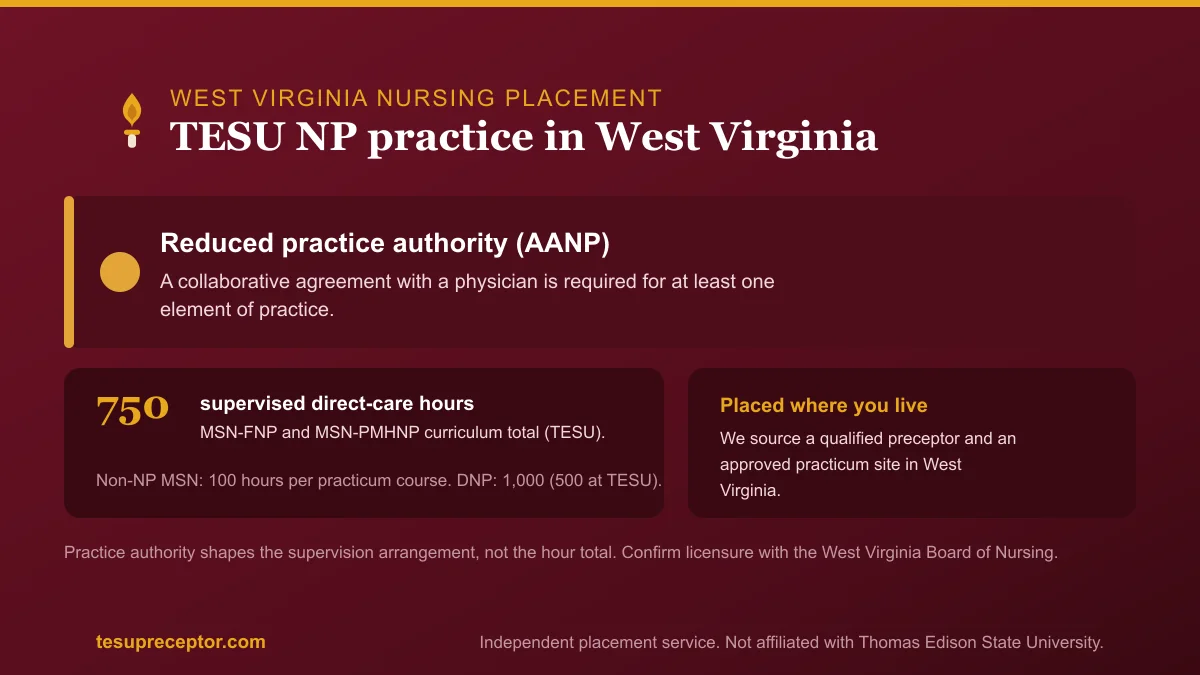
AANP classifies West Virginia as Reduced Practice, a framework for licensed NP work across the Charleston, Morgantown, and Huntington corridor. TESU currently lists NP study as available in West Virginia, with each course, preceptor, site, and term reviewed separately, including for work centered on the Charleston, Morgantown, and Huntington corridor.
Tell us your program and city. It is free to ask, with no obligation.
Fit the West Virginia search to weekly access
Charleston, Huntington, and Morgantown provide West Virginia's largest clinical and organizational clusters. Parkersburg, Wheeling, Beckley, Martinsburg, Clarksburg, and Fairmont create additional regional searches when the setting matches the course.
Mountain roads and winter weather can turn a modest West Virginia distance into an unreliable weekly trip. Border prospects in Ohio, Pennsylvania, Maryland, Virginia, or Kentucky must be treated as placements in those jurisdictions, not as extensions of a West Virginia search. A candidate in West Virginia needs more than an hour total. Share the exact course, dates, learning needs, weekly availability, and the commute the student can maintain across the term.
What current TESU availability means in West Virginia
An admitted student may plan TESU NP work in West Virginia because the university currently shows that pathway as available. Within the Charleston, Morgantown, and Huntington corridor, each prospect still needs current credentials, suitable patient access, organizational consent, and course approval.
Availability extends to the non-NP MSN specialties and DNP, subject to individual review. The Charleston, Morgantown, and Huntington corridor may contain several kinds of hosts, but a primary care office, education department, informatics team, executive mentor, and DNP project site solve different academic needs.
AANP category and West Virginia credential checks
AANP classifies West Virginia as a Reduced Practice state. In AANP's framework, state law limits at least one element of NP practice or requires a regulated collaborative relationship for part of care. The AANP label explains the professional environment in West Virginia; it does not expand a student's approved course activities.
The licensing checkpoint for West Virginia is the West Virginia RN Board Licensing. Search the candidate's legal identity, confirm the relevant active credential and population scope, and compare the record with the proposed duties. State verification is necessary, but university approval remains separate.
CITI and IRB steps shape the West Virginia DNP plan
The West Virginia DNP site must support an evidence-based systems-level quality-improvement project and the student's approved practicum work. CITI ethics preparation comes first, followed by agency IRB approval or a determination letter, then TESU IRB submission after NUR-9020 and approval before NUR-9120. A supportive mentor cannot grant data or implementation access without organizational authority. That requirement remains active across the Charleston, Morgantown, and Huntington corridor.
TESU collaborates while the student identifies candidates
A West Virginia student should actively identify qualified candidates, but TESU is not absent from the process. Its nursing staff collaborate with students, verify proposals, assess course fit, and require site authorization and any necessary agreement before the practicum or project can start. That checkpoint is applied through the Charleston, Morgantown, and Huntington corridor.
Students may use a third-party vendor to find West Virginia prospects, but TESU does not route its academic review through that vendor. We source physical candidates and prepare the relevant facts; TESU contacts the proposed preceptor or site directly and retains every approval decision. A match is never a guarantee of credit. The Charleston, Morgantown, and Huntington corridor gives this requirement its practical search boundary.
Keep NP, non-NP MSN, and DNP hours separate
For FNP, TESU sets a curriculum total of 750 supervised direct patient care hours. PMHNP likewise totals 750 supervised direct patient care hours. A site within the Charleston, Morgantown, and Huntington corridor must match the active course, population focus, schedule, and preceptor role before its capacity matters.
For non-NP MSN study, the current program pages identify one required 100-hour NUR-7510 practicum and its on-ground supervised project work. A contradictory FAQ makes the enrolled degree audit decisive for prospects in the Charleston, Morgantown, and Huntington corridor. The DNP minimum is 1,000 supervised post-baccalaureate hours, and at least 500 must be completed at TESU.
Patient location controls the state check
A qualifying PMHNP practicum can include telemedicine, but TESU limits it to 50 percent of each eight-week term, which is 62.5 hours out of 125. The approved preceptor provides full virtual presence. Patient location, not the platform, determines which state rules apply around the Charleston, Morgantown, and Huntington corridor.
Treat any virtual-capable lead in the Charleston, Morgantown, and Huntington corridor as unapproved until the student receives written TESU direction for the course, site, and state. The candidate file must still establish licensure, site permission, privacy, technology, patient access, and full supervision. No outside service can guarantee academic acceptance or countable hours.
Turn the West Virginia plan into a reviewable brief
Trusted by nursing students and working nurses. Placement intake for the Charleston, Morgantown, and Huntington corridor should name the exact TESU degree path, course, dates, required access, clinical-day options, travel area, licensure, and choice between physical sourcing and conditional PMHNP telemedicine review.
Submit a free placement review for a focused search through the Charleston, Morgantown, and Huntington corridor. We present the candidate for student review before payment, and payment is due only when matched. The proposed arrangement remains subject to TESU and host approval.
Good to know
What clinical-hour totals apply to TESU nursing students in West Virginia?
TESU requires 750 direct patient care hours for FNP and 750 for PMHNP, including for work centered on the Charleston, Morgantown, and Huntington corridor. Current non-NP MSN pages show one 100-hour NUR-7510 on-ground practicum plus a project, subject to the active degree audit, including for work centered on the Charleston, Morgantown, and Huntington corridor. A DNP plan using the Charleston, Morgantown, and Huntington corridor needs at least 1,000 supervised post-BSN hours, with at least 500 completed at TESU.
Can a TESU PMHNP student use telemedicine involving West Virginia?
PMHNP telemedicine is capped at 50 percent of each eight-week term, or 62.5 of 125 hours, with the preceptor in full virtual presence, including for work centered on the Charleston, Morgantown, and Huntington corridor. For the Charleston, Morgantown, and Huntington corridor, patient physical location controls the state review, and written TESU, course, site, state, licensure, and host approvals are required.
Does TESU currently permit NP study in West Virginia?
Yes. TESU currently lists NP study as available in West Virginia. A prospect from the Charleston, Morgantown, and Huntington corridor still needs admission, active licensure, course alignment, preceptor and site approval, organizational consent, and any required agreement before hours begin.
What AANP practice category applies in West Virginia?
AANP places West Virginia in reduced practice. That classification describes licensed NP authority across the Charleston, Morgantown, and Huntington corridor; it does not expand a TESU student's supervised role or replace Board, site, course, preceptor, and university review.
Do not let the search cost you a term
Tell us your TESU program, your city, and your practicum timeline. We will come back with a placement plan and a realistic path to a preceptor and your clinical hours.