Build a TESU Nursing Placement Plan for Wisconsin
AANP classifies Wisconsin as Reduced Practice, a framework for licensed NP work across the Milwaukee, Madison, and Green Bay triangle. TESU currently lists NP study as available in Wisconsin, with each course, preceptor, site, and term reviewed separately, including for work centered on the Milwaukee, Madison, and Green Bay triangle.
Tell us your program and city. It is free to ask, with no obligation.
Open for review is not automatic approval in Wisconsin
Current TESU status allows FNP and PMHNP placement review in Wisconsin. The Milwaukee, Madison, and Green Bay triangle is therefore a valid sourcing area, not a blanket approval for any practitioner or clinic found there.
Non-NP MSN and DNP options remain available as well. For a student using the Milwaukee, Madison, and Green Bay triangle, current residence, license, course, site, and term details should be checked before contacting prospects because any of them can alter eligibility or fit.
Treat Wisconsin as a set of local markets
Milwaukee has Wisconsin's largest clinical market, while Madison provides another broad center. Green Bay and the Fox Cities form a northeastern corridor; Eau Claire, La Crosse, Wausau, Racine, Kenosha, and Superior add regional options.
Wisconsin searches should pair the student's actual weekly availability with winter travel and the host's onboarding calendar. A placement that works in summer may require a different commute plan during an eight-week term affected by snow or early start times. For Wisconsin, define the student's course and term first, then add the patient group or organizational work, days available, preferred setting, and realistic travel corridor.
A Wisconsin lead is only the start of approval
The student initiates the Wisconsin search under TESU's out-of-state workflow. TESU advisors and administrators work with the student, then the university verifies the preceptor and site, reviews the intended activities, and communicates required agreement steps with the organization. The Milwaukee, Madison, and Green Bay triangle gives this requirement its practical search boundary.
Physical sourcing and candidate organization can be delegated to a third party, but TESU's relationship remains directly with the proposed Wisconsin preceptor and site. The student should expect to submit accurate contact and credential information, then let TESU conduct its own review. Neither interest nor payment guarantees acceptance. Prospects across the Milwaukee, Madison, and Green Bay triangle pass through this same screen.
What the Wisconsin practice label does and does not do
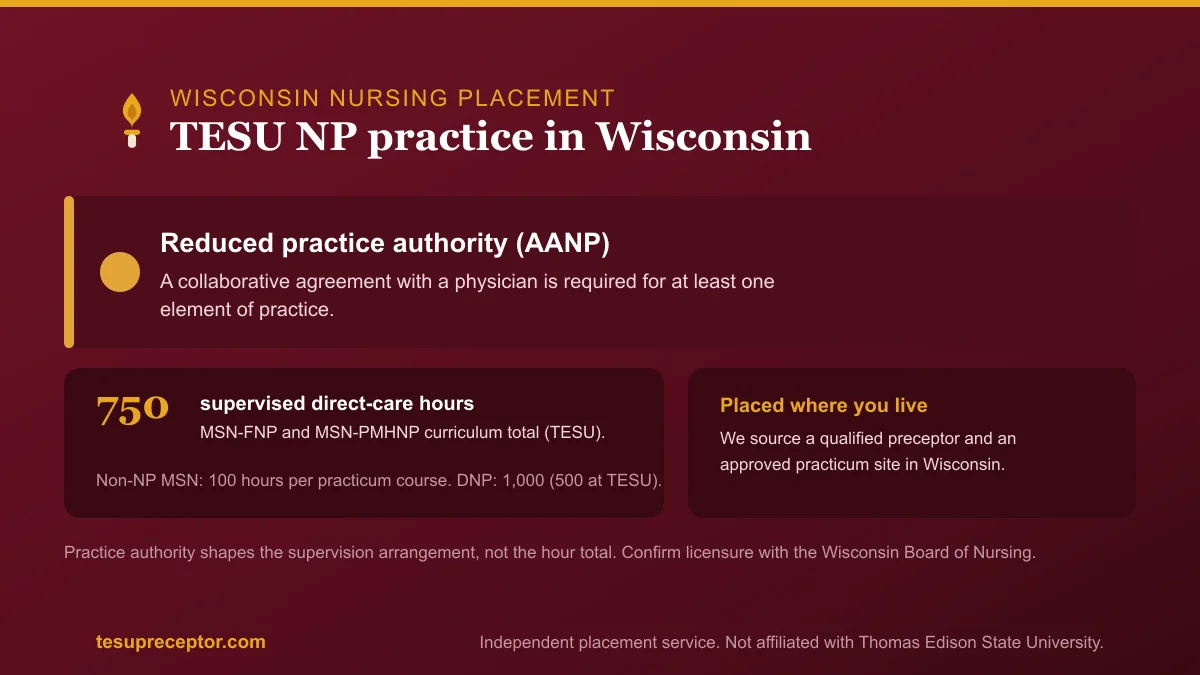
AANP classifies Wisconsin as a Reduced Practice state. In AANP's framework, state law limits at least one element of NP practice or requires a regulated collaborative relationship for part of care. This statewide category does not turn a student into an autonomous practitioner or excuse TESU supervision.
A proposed mentor's Wisconsin credentials should be checked through the Wisconsin DSPS Advanced Practice Nurse Prescriber, not accepted from a website biography alone. The license record, current role, population focus, and practice setting all belong in the screening file that TESU will evaluate.
Keep the 62.5-hour PMHNP limit visible
The PMHNP virtual provision is limited rather than fully remote: telemedicine may supply at most 50 percent of each eight-week term, or 62.5 of 125 hours. TESU requires the approved preceptor's full virtual presence. A patient physically in the Milwaukee, Madison, and Green Bay triangle brings that jurisdiction into the encounter review.
The Milwaukee, Madison, and Green Bay triangle proposal follows the same site, credential, supervision, privacy, and technology checks as physical placement. Written TESU approval must identify the course, site, and state before telemedicine hours are treated as countable. Published permission is limited to PMHNP and does not establish a virtual option for another pathway.
Use the student's TESU degree plan for hour screening
TESU's FNP pathway requires 750 supervised direct patient care hours; the PMHNP pathway requires its own 750 supervised direct patient care hours. The useful question in the Milwaukee, Madison, and Green Bay triangle is whether the proposed setting can support this term's approved encounters and supervision.
The present non-NP MSN requirement is one 100-hour NUR-7510 practicum combining on-ground supervision with a course project. Because another official FAQ refers to two practicums, use the active catalog and degree audit before approaching the Milwaukee, Madison, and Green Bay triangle. DNP students need 1,000 or more supervised post-BSN hours, with at least 500 completed at TESU.
A Wisconsin DNP mentor needs organizational access
DNP sourcing in Wisconsin should begin with the project question and the organization able to authorize it. TESU's sequence includes CITI ethics training, agency IRB approval or determination, and TESU IRB review after NUR-9020 but before NUR-9120. The proposed setting must support a systems-level evidence-based quality-improvement intervention. The Milwaukee, Madison, and Green Bay triangle gives this requirement its practical search boundary.
Prepare the facts before requesting Wisconsin help
Trusted by nursing students and working nurses. Start a search across the Milwaukee, Madison, and Green Bay triangle with the course and term, total hours, weekly availability, patient or project needs, sustainable drive, student license, and whether the request is physical or a limited PMHNP virtual-capable proposal.
Bring the completed brief to a free placement review for the Milwaukee, Madison, and Green Bay triangle. The student can inspect the proposed match before paying and pays only after matching. No service can promise that TESU or the organization will accept the proposal or count its hours.
Good to know
Can a TESU PMHNP student use telemedicine involving Wisconsin?
PMHNP telemedicine is capped at 50 percent of each eight-week term, or 62.5 of 125 hours, with the preceptor in full virtual presence, including for work centered on the Milwaukee, Madison, and Green Bay triangle. For the Milwaukee, Madison, and Green Bay triangle, patient physical location controls the state review, and written TESU, course, site, state, licensure, and host approvals are required.
Does TESU currently permit NP study in Wisconsin?
Yes. TESU currently lists NP study as available in Wisconsin. A prospect from the Milwaukee, Madison, and Green Bay triangle still needs admission, active licensure, course alignment, preceptor and site approval, organizational consent, and any required agreement before hours begin.
What AANP practice category applies in Wisconsin?
AANP places Wisconsin in reduced practice. That classification describes licensed NP authority across the Milwaukee, Madison, and Green Bay triangle; it does not expand a TESU student's supervised role or replace Board, site, course, preceptor, and university review.
What clinical-hour totals apply to TESU nursing students in Wisconsin?
TESU requires 750 direct patient care hours for FNP and 750 for PMHNP, including for work centered on the Milwaukee, Madison, and Green Bay triangle. Current non-NP MSN pages show one 100-hour NUR-7510 on-ground practicum plus a project, subject to the active degree audit, including for work centered on the Milwaukee, Madison, and Green Bay triangle. A DNP plan using the Milwaukee, Madison, and Green Bay triangle needs at least 1,000 supervised post-BSN hours, with at least 500 completed at TESU.
Do not let the search cost you a term
Tell us your TESU program, your city, and your practicum timeline. We will come back with a placement plan and a realistic path to a preceptor and your clinical hours.